Showing posts with label pakistan folk stories. Show all posts
Showing posts with label pakistan folk stories. Show all posts
30 Jul 2011


Sohni Mahiwal
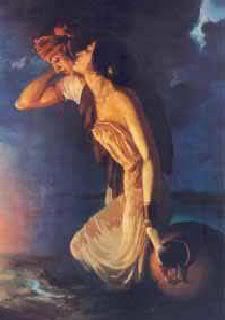
I chose the story of Sohni and Mahiwal for this post because I find it so touching, so tragic, and so real. Even though Sohni and Mahiwal lived, loved and died, relatively recently there is no one consistent account of their story. However, there is an unmistakable common thread that runs through the different versions.
Sifting through different accounts and glossing over some, here is, briefly, what I could gather of this beautiful and enduring story:
Sometime during the late Mughal period, there lived in a town on the banks of the Chenab, or one of its branches, a potter (kumhar) namedTulla. (The town is identified either as present day Gujrat or one of the nearby towns.) Tulla was a master craftsman and his earthenware was bought and sold throughout Northern India and even exported to Central Asia. To the potter and his wife was born a daughter. She was such a beautiful child that they named her Sohni, meaning beautiful in Punjabi.
Sohni spent her childhood playing and observing things in her father’s workshop. She watched clay kneaded and molded on the wheel into different shaped pots and pitchers, dried in the sun, and then fired and baked. Sohni grew up not only into a beautiful, young woman but also an accomplished artist who made floral designs on the pots and pitchers that came off her father’s wheel.
 Sohni’s town was located on the trading route between Delhi and Central Asia, and trading caravans often made a stopover here. One such caravan that stopped here included a young, handsome trader from Bukhara, named Izzat Baig. While checking out the merchandise in town, Izzat Baig came upon Tulla’s workshop where he spotted Sohni sitting in a corner of the workshop painting floral designs on the pots. Izzat Baig was taken by Sohni’s rustic beauty and charm and couldn’t take his eyes off her. In order to linger at the workshop, he started purchasing random pieces of pottery. He returned the next day and made some more purchases at Tulla’s shop. His purchases were a pretext to be around Sohni for as long as he could. This became Izzat Baig’s routine until he had squandered most of his money.
When the time came for his caravan to leave, Izzat Baig found it impossible to leave Sohni’s town. He told his companions to leave, and that he would follow later. He took up permanent residence in the town and would visit Sohni at her father’s shop on one pretext or the other. Sohni also began to feel the heat of Izzat Baig’s love and gradually began to melt. The two started meeting secretly.
 Izzat Baig soon ran out of money and started taking up odd jobs with different people, including Sohni’s father. One such job was that of grazing people’s cattle — mainly buffaloes. Because of his newfound occupation people started calling him Mahiwal, a short variation of Majhan-wala or the buffalo-man. That name stayed with him for the rest of his life — and thereafter.
Sohni and Mahiwal’s clandestine meetings soon became the talk of the town. When Sohni’s father came to know about the affair he hurriedly arranged Sohni’s marriage with one of her cousins, also a potter, and, ignoring Sohni’s protests and entreaties, bundled her off to her new home in a village somewhere on the other side of the river.
Mahiwal was devastated. He left town and became a wanderer, searching for Sohni’s whereabouts. Eventually, he found her house and managed to meet her in the guise of a beggar and gave her his new address — a hut across the river. Sohni’s husband, meanwhile, discovering that he could not win Sohni’s heart no matter what he did to please her, started spending more time away from home on business trips. Taking advantage of her husband’s absence, Sohni started meeting Mahiwal regularly. She would swim across the river at night with the help of a large water pitcher (gharra), a common swimming aid in the villages even today. They would spend most of the night together in Mahiwal’s hut and Sohni would swim back home before the crack of dawn. On reaching her side of the river, she would hide the pitcher in a bush to be used for her next trip the following night.
 One day, Sohni’s sister-in-law (her husband’s sister) came visiting. Suspecting something unusual about Sohni’s nocturnal movements, she started spying on her. She followed Sohn,i one night, and saw her take out the pitcher from the bush, wade into the river and swim across. She reported the matter to her mother (Sohni’s mother-in-law). Both of them, rather than informing Sohni’s husband, decided to get rid of Sohni. This, they believed, was the only way to save their family’s honor. The sister-in-law quietly took out Sohni’s pitcher from the bush and replaced it with sun-dried, unbaked pitcher.
As usual, Sohni set out at night for her meeting with Mahiwal, picked the pitcher from the bush, as she always did, and entered the river. It was a stormy night. The river was in high flood. Sohni was soon engulfed in water. She discovered, to her horror, that the pitcher had begun to dissolve and disintegrate.
What shall she do now? Different thoughts rushed through Sohni’s mind. Abandon the trip? Or continue trying to swim without the help of a pitcher — and drown? Her inner struggle at this point is best expressed in a saraiki song made memorable by Pathanay Khan in his inimitable voice: Sohni gharray nu aakhdi aj mainu yaar mila gharrya
Roughly translated and paraphrased the song runs as follows:
Sohni (addressing the pitcher):
It’s dark and the river is in flood
There is water all around me
How am I going to meet Mahiwal?If I keep going, I will surely drown
And if I turn back
I would be going back on my promise
And letting Mahiwal downI beg you (O pitcher!), with folded hands,
Help me meet my Mahiwal
You always did it, please do it tonight, too
(The pitcher replies):
I wish I, too, were baked in the fire of love, like you are
But I am not. I apologize; I cannot help
Hearing Sohni’s cries, Mahiwal, from the other side, jumped into the river to save her. He barely managed to reach her. As the story goes, their bodies were washed ashore, and were found the next day, lying next to each other.
With their death, Sohni and Mahiwal entered into the world of legends and lore. And, in their death the sinners became saints.
29 Jul 2011
Sassi Punnu

In the southern tip of present-day Pakistan in the Sindh province, there once was a raja that mightily ruled the lands of Bhambour. He had had many children but was blessed with only one daughter. She was named Sassi, meaning the moon, for they thought she was as pure and splendid as the moon. When she was born, the raja and his wife went to an astrologer to learn of their daughter’s fate. The wise astrologer prophesied to the parents that their one and only daughter would bring great shame to her parent’s honor. Saddened, the poor parents had no other choice. Sassi could not stay there. They could not bear to kill their child. Instead, they placed their beautiful daughter in a basket to send down the Indus River. Before placing her in the basket, however, Sassi’s mother tied a taweez filled with a prayer around her daughter’s neck for protection.
Downstream, a poor dhobi was washing clothes, a hard day’s labor for a meager wage. This poor man named Atta had a wife but they could not conceive a child. They had prayed for many years but to no avail. While finishing up the last of the shirts he had in his bundle, the dhobi saw something strange floating on the river. He watched as it got caught in some bushes. It was a basket. He took it out of the river and saw that within was the most precious baby girl he had ever seen. The first name to come out of his mouth was Sassi. He took her home to show his wife the answer to their prayers.
So as it is, Sassi grew up the daughter of a poor dhobi. She was happy. She knew no other life. As she grew older, her beauty grew deeper. She became known for her charming looks throughout the land. Hearing about her, the raja of the land sent for this young woman. As summoned, she went to the palace to be before the raja. There, the raja’s wife saw the taweez still around Sassi’s neck and knew at once that this was her daughter. Happy to be together again, the raja insisted that she stay with them in the palace. However, Sassi could not bear to leave the poor old dhobi and his wife, who raised her all these years. Still, the raja made relentless efforts to win her back.
In another one of the raja’s attempts, the raja invited Sassi to a large garden made by a neighboring raja. As she explored the depths of the garden, she saw the most beautiful painting of a young man. She fell in love with his strong stature and noble appearance. She had to meet this man. Word traveled fast. The man in the painting heard of this beautiful woman wanting to meet him so he disguised his true identity as the Prince Punnu and dressed as a trader of art to meet Sassi. They fell in love and began to blossom as lovers.
Sassi, who had disregarded her royal birth and biological parents, continued to live as a dhobi’s daughter and nothing more. Punnu did not know her past and she would not dare to tell it. To him, she was a dhobi's daughter and to her, he was a mere art trader. When it came time for Punnu to ask for Sassi’s hand in marriage, the only parents he knew to ask were the dhobi and his wife. The dhobi knew the importance of a humble husband, whether he be a prince or a peasant. He decided to test Prince Punnu and told him that if he could correctly wash a shirt, then he would be able to wed his daughter, Sassi. Punnu, who had never washed a single article of clothing, was unable to wash the shirt in the river against the rocks like a dhobi. The shirt came back torn. The prince offered large amounts of gold coins to compensate for his failed attempt and grudgingly the dhobi took it, knowing that his daughter’s heart would only be happy with Punnu.
Next came time for Sassi to gain approval from Punnu’s family. Punnu went to speak with his parents. However, when Punnu spoke with his parents about Sassi, they flatly refused because she was the daughter of a dhobi. No way could a prince marry a daughter of a poor man who washes other people’s laundry for a living. Punnu would not be swayed. His heart was set on Sassi. No one else would do.
Seeing this, Punnu’s family decided to pretend to go on with the wedding. In celebration, Punnu’s brothers decided to take him drinking the night before the wedding. His brothers gave him a large glass to drink. Punnu drank and drank until he passed out. Then, Punnu’s brothers took their brother far away from the wedding celebrations to another village. With Punnu in a different state of mind and place, the wedding could not go on.
Sassi heard the sad news on her wedding night, while she was getting dressed for the ceremony. Afraid of what would become of her Punnu, Sassi, while still wearing her wedding clothes, ran across the desert sands toward the village, calling out to her Punnu. Halfway through her journey, she saw a shepherd and asked for some water. The shepherd saw her beauty. He could not rest until she was his. He grabbed her and she cried out to the heavens for help.
Meanwhile, Punnu had regained his senses back in the village he had been taken to. When he realized that his family had tricked him, he too ran just as Sassi had, across the desert, calling out the name of his love. He was about halfway there when he heard Sassi calling out.
Suddenly, through Sassi’s pleas to the skies, the ground shook underneath them and split into two. The earth swallowed up both Sassi and Punnu. Now, in that same place, there are two mountains that remain together for eternity.
Wow,” replied my mother. Out of all the stories she knew, she could not recall this one. She had vaguely heard of Sassi and Punnu but did not know the details.
“Baba, where are these mountains?” asked Reza.
“There are in the Sindh near Balouchistan. It is said that if you listen closely when you are in the valley of the mountains, you can still hear the names ‘Sassi’ and ‘Punnu’ being whispered,” added my husband rather coolly.
“Come on, kids,” I said. “Time for bed.”